



Researchers from the University of Illinois, Chicago report that doxorubicin, a long-established cancer drug, can block the herpes simplex virus type 1 (HSV-1) in laboratory models and in mice. Their findings suggest we might see a new treatment option alongside existing antivirals, like acyclovir, on the shelves, but not just yet. This drug has a few hurdles to jump before it’s ready for clinical use against the herpes virus.
Most people carry the Herpes Simplex virus without knowing it. For the majority, it stays quiet, occasionally surfacing as a cold sore or staying hidden entirely. For cancer patients, transplant recipients and others whose immune systems are compromised, however, the same virus can cause sight-threatening eye infections, brain inflammation and in severe cases, death.
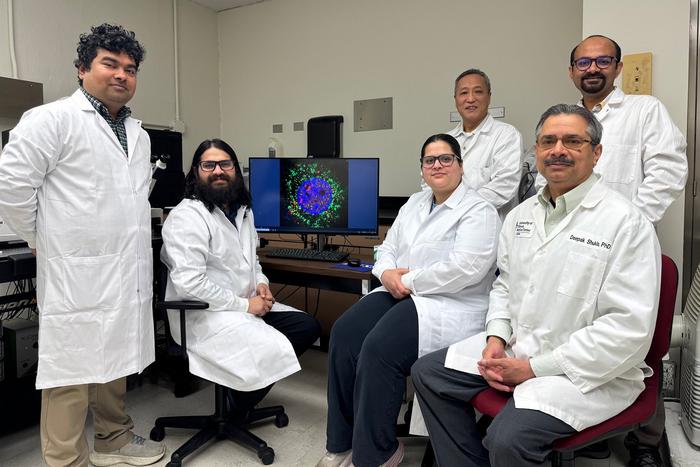
Study leader Deepak Shukla, a virologist at UIC’s College of Medicine explained in a press release.
‘This opens up an unexpected, potentially fast-moving path toward treating drug-resistant herpes infections…HSV-1 infections have serious, sometimes life-threatening consequences, and this drug may help save lives.’
A new hope for Herpes?
For forty years, doctors have had basically one tool to manage it: a family of antiviral drugs led by acyclovir. Now a team at the University of Illinois, Chicago has found that a second tool, one already sitting in hospital pharmacies, might work too.
The drug is doxorubicin (AKA Adriamycin), a chemotherapy medication used to treat breast cancer, lymphoma, and other cancers since the 1960s. In a study published this January in the journal Drug Resistance Updates, the UIC team showed that doxorubicin can block Herpes Simplex Virus type 1 (HSV-1) from infecting and replicating in human cells, pig corneal tissue, and mice; including rare strains of the virus that no longer respond to acyclovir.
Why a cancer drug? The short answer is that it came up in a computer search. In 2024, Shukla’s lab built a digital screening tool called HerpDock, which combs through the libraries of known chemical compounds and flags the ones that might be effective against herpes.
Off patent, on target
When HerpDock highlighted doxorubicin, the team took notice. Not just because it worked in the simulation, but because it was already approved by the FDA.
‘We were excited when we realized that doxorubicin is already FDA-approved,’ said Shukla. ‘That matters because its safety profile and dosing are already well understood. This drug could reach clinicians and patients much faster than a brand-new discovery.’
That is a bigger deal than it might sound. Getting a new drug from a laboratory result to a pharmacist’s shelf typically takes over a decade and costs billions of dollars. An existing approved drug skips much of that queue.
Locking out unwelcome guests
Current herpes antivirals like acyclovir work by targeting the virus directly. This means they gum up the machinery the virus uses to copy its DNA. That strategy has worked well for decades, but it means the drugs are only effective as long as the virus doesn’t change enough to work around them and for people with compromised immune systems, a long and strong course of acyclovir family members can take a toll.
Doxorubicin takes a different approach. Rather than going after the virus itself, it blocks a signalling pathway inside human cells, a chain of molecular switches called PI3K-AKT-mTOR, that HSV-1 needs to get inside cells and start replicating. Think of it like changing the locks on the door the virus uses to break in, rather than trying to stop the virus in transit.
Since this pathway is part of the host cell rather than the virus, it is much harder for the virus to evolve around it. That is partly why the drug worked successfully against acyclovir-resistant strains in the study; strains that current drugs simply cannot touch.
Evidential enquiries
While Herpdock identified doxorubicin’s potential, Shukla’s team still had to confirm that the drug really could block herpes infections. These early stages of evidence gathering took place in the laboratory. This was not a clinical trial; no people were involved.
The team worked through three levels of testing, each step more complex than the last.
First, they tested doxorubicin in human cells in a dish in the lab, including corneal cells and cancer cell lines. The drug consistently reduced the number of virus particles that could replicate and did so at concentrations much lower than those used for cancer treatment. This matters because the main concern with doxorubicin is its toxicity at high doses.
Second, they used pig corneas, infected with HSV 1– a model that closely mimics human eye infections. The drug again cut viral levels significantly, particularly when combined with trifluridine, the standard eye drop antiviral.
Third, mice infected with HSV-1 in the eye were treated topically with doxorubicin eye drops. Viral levels in the eyes dropped, corneal damage was reduced, and crucially, there were no signs of drug-related toxicity to the heart, blood cells, or surrounding tissue, which is the standard worry with systemic doxorubicin.
The doses used in these eye-drop experiments were roughly 3,000 times lower than the concentration of trifluridine used in standard treatment, and they achieved comparable results.
The acyclovir connection
One of the study’s more practical findings was what happened when doxorubicin and existing antivirals were given together. The combination produced results well beyond what either drug managed alone. In some cell-culture experiments, pairing the two reduced viral load by hundreds to thousands of times more than either drug by itself.
This matters because acyclovir, taken long-term and at the doses sometimes required in immunocompromised patients, can damage the kidneys. If a small amount of doxorubicin allows the same viral suppression with a lower acyclovir dose, that could reduce the risk for patients who need sustained treatment.
‘I enjoyed being a part of something that can really help people,’ said Divya Kapoor, a graduate student researcher and co-author on the study. ‘This discovery has the potential to prevent herpes-related deaths and improve patient outcomes around the world, including for cancer patients who use doxorubicin.’
The final stretch
The researchers are clear that more work is needed before this becomes a treatment option. The next step will be human clinical trials, which take time to design, fund, and run. But because doxorubicin is already approved, the safety groundwork has largely been laid, which typically removes years from the process.
The people most likely to benefit first are those whose immune systems are already compromised. Chemotherapy patients in particular face a well-documented risk of herpes reactivation. The virus, which lies dormant in nerve tissue in most adults, can flare up when the immune system is suppressed. The researchers point out that some cancer patients already receiving doxorubicin might be getting some inadvertent protection against this, a question worth investigating.
For the general population with recurrent cold sores or genital herpes, a topical doxorubicin product (an eye drop or cream, for instance) is a more plausible near-term application. The drug would not need to circulate through the whole body at cancer-chemotherapy levels to be useful.
An old cancer drug, a new drug for Herpes
HSV-1 infects an estimated four billion people worldwide, according to the World Health Organization, making it one of the most common viral infections in existence. It is also the leading infectious cause of blindness globally. A new treatment option, particularly one that works through a mechanism the virus cannot easily evolve around, would fill a gap that has been open for a long time.
References
Sharma P, et al. (2026). Host-directed novel mechanistic insights of doxorubicin reveal its efficacy against drug-resistant HSV-1 underscoring risks with oncolytic virotherapy. Drug Resistance Updates, 86, 101362. https://doi.org/10.1016/j.drup.2026.101362
University of Illinois Chicago/EurekAlert press release (March 24, 2026): ‘UIC research: A cancer drug that treats herpes, too.’ https://www.eurekalert.org/news-releases/1121079
World Health Organization (2023). Herpes simplex virus. https://www.who.int/news-room/fact-sheets/detail/herpes-simplex-virus
Sandherr M, et al. (2006). Antiviral prophylaxis in patients with haematological malignancies and solid tumours. Annals of Oncology, 17(7), 1051–1059. [Re: HSV reactivation risk during chemotherapy – cited in primary paper]
Kapoor D, Sharma P, Shukla D (2024). Emerging drugs for the treatment of herpetic keratitis. Expert Opinion on Emerging Drugs, 29(2), 113–126. [HerpDock tool – cited in primary paper]
